Why I’m Betting 90% on Google (The "Solar System" Strategy for 2026)
⚡ Key Takeaways:
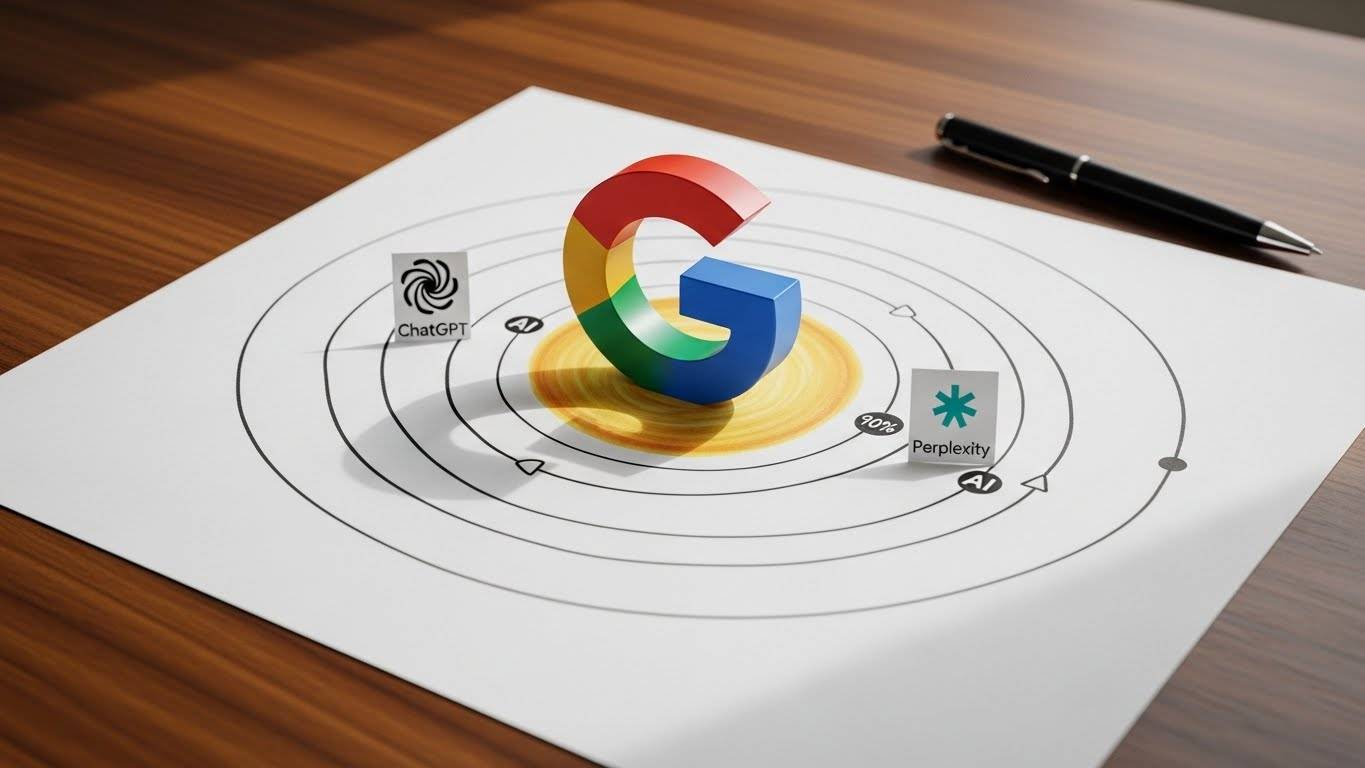
The Myth: "ChatGPT killed Google." The Reality: Google is still the "Sun" of the internet (90% of gravity).
The "Solar System" Model: We treat Google as the Star and ChatGPT/Perplexity as planets. You don't ignore the Sun to terraform Mars.
The New 50/30/20 Rule: My new resource allocation: 50% Third-Party RAG, 30% Website Assets, 20% Brand.
In late 2022, the SEO industry hit "Code Red."
ChatGPT launched, and the headlines screamed: Google is Dead.
I admit, I panicked too. I looked at my old SEO spreadsheets and felt like a typewriter repairman in the age of the iPhone. I thought, "Why would anyone search for a blue link when they can ask a chatbot?"
For three months, I chased every shiny object. I tried to optimize for Bing. I tried to optimize for ChatGPT plugins. I tried to optimize for tools that don't even exist anymore.
But three years later, I looked at the actual data in the Infomly Lab.
The traffic wasn't moving to ChatGPT as fast as the gurus predicted. Google wasn't dying; it was mutating.
If you are a "Creative Generalist" or a Solo Founder, you have limited time. You cannot optimize for every new AI tool that launches on Product Hunt. You need a prioritization map.
I call mine The Solar System Strategy.
The "Solar System" Visualization
To survive 2026, you have to stop looking at the internet as a list of websites and start looking at it as a Gravity Well.
Gravity = User Attention + Data Dependence.
☀️ The Sun (Google): It holds 90% of the gravity. It powers traditional search, YouTube (the 2nd largest engine), Gemini, and Android. It is massive, hot, and inescapable. Even when people use Apple Intelligence, often the query falls back to Google.
🪐 Jupiter (ChatGPT): Massive and growing. It has its own gravity (users who go directly to chatgpt.com). But it still often orbits the data created by the rest of the web.
🌑 The Moons (Perplexity, Claude, Grok): Interesting, specialized, but they don't have the gravity to build a business on yet. Grok is isolated on Mars (X/Twitter). Claude is powerful but niche (coders).
The Mistake: Most creators are currently trying to terraform Mars (optimize for Grok) while ignoring the Sun (Google).
The Strategy: I am spending 90% of my effort on the Sun and 10% on Jupiter.
Why Google Is Still The "Database" (RAG)
Here is the technical reality that most people miss: AI models don't just "know" things; they "retrieve" things.
This is called RAG (Retrieval-Augmented Generation).
When you ask ChatGPT a current question about a new iPhone release, where does it look? It browses the web (often via Bing).
When you ask Gemini, where does it look? The Google Index.
When you ask Perplexity, where does it look? A mix of Google and Bing.
Even if the interface becomes a Chatbot, the database is still the Search Index.
My Hypothesis:
To rank in AI, you don't "beat" the search engine. You become the cleanest, most structured Database Entry in the index so the AI can fetch you easily.
If you abandon your website (The Database Entry), the AI has nothing to fetch. You become invisible.
The "Fair Exchange" is Broken (And How to Fix It)
For 20 years, the internet ran on a simple deal:
I write content.
Google scrapes it.
Google gives me traffic.
In the "Gemini Era," that deal is broken.
Now:
I write content.
Google scrapes it.
Google answers the user directly (Zero Clicks).
Most SEOs are crying about this. But as a Strategist, I see a different opportunity.
Neil Patel recently released data showing that while AI traffic volume is lower, AI traffic converts 23x higher than traditional search.
Why? Because the user isn't "browsing." They are "deciding."
When someone asks Gemini, "What is the best CRM for a 3-person team?", they aren't looking for a history of CRMs. They have their credit card out.
If Gemini mentions Infomly in that answer, I don't need 1,000 clicks. I need that one high-intent user.
My New Resource Allocation: The 50/30/20 Rule
So, knowing that the "Fair Exchange" is broken but "Decision Traffic" is worth gold, how do I actually spend my day?
I used to spend 100% of my time writing blog posts. That is suicide now.
Here is the new breakdown I am using for Infomly in 2026.
1. The Website (30% Focus) - "Anti-AI Assets"
I no longer write generic "How To" guides on my site. AI can answer those instantly.
I only publish Anti-AI Assets (things AI cannot fake).
Proprietary Data: Instead of "SEO Tips," I write "I analyzed 500 keywords and found this pattern."
First-Hand Stories: "How I lost $500 on Facebook Ads." AI cannot hallucinate my pain (yet).
Free Tools: Simple Javascript calculators. AI can write code, but users still like a clean UI to click buttons on.
2. Third-Party RAG (50% Focus) - "Feeding the Machine"
This is the biggest shift. I spend half my time off-site.
Why? Because AI trusts "Consensus."
If ChatGPT sees "Infomly" mentioned on Reddit, LinkedIn, and G2, it assigns a higher "Trust Score" to my brand.
Reddit & LinkedIn: I don't just drop links. I write full summaries of my experiments.
Reviews: I aggressively gather reviews on Trustpilot.
The Goal: When the AI looks around the web to see if "Infomly" is legit, it finds footprints everywhere.
3. Brand Assets (20% Focus) - "The Narrative"
I use YouTube and Social to control the sentiment.
If I don't define who I am, the AI will hallucinate a definition for me. I constantly feed the internet phrases like "The Infomly Protocol" or "The Solar System Strategy" so the AI learns to associate these unique terms with my brand.
Action Plan: My "Solar System" Routine
Theory is useless without execution. Here is exactly what my Monday-Friday schedule looks like under this new strategy.
Table: The Creative Generalist's Weekly Routine
Day
Task
Focus Area (50/30/20)
Monday
Run an Experiment (e.g., Test a new tool).
30% (Website)
Tuesday
Write the "Anti-AI" Post (Data & Story).
30% (Website)
Wednesday
Summarize findings on LinkedIn/Reddit.
50% (Third Party)
Thursday
Audit "Brand Mentions" (Check Perplexity).
20% (Brand)
Friday
Update Old Posts (Refresh Data for RAG).
30% (Website)
The "Tale of Two Creators"
To visualize why this matters, let me tell you a quick story about two hypothetical SEOs: Trend-Chasing Tim and Solar Sarah.
Trend-Chasing Tim saw Grok launch and spent 3 months optimizing his X (Twitter) feed. He ignored his website. Then, X changed its algorithm, and his traffic went to zero. He built his house on a rogue planet.
Solar Sarah (that's us) ignored the hype. She kept her website clean (HTML-first). She published data tables. She got mentioned on Reddit.
When Google launched "AI Overviews," Sarah's site was the primary citation.
When ChatGPT browsed the web, it found Sarah's Reddit threads and cited her.
Sarah didn't chase the AI. She stood still and let the AI come to her.
Final Verdict
Don't let the hype distract you.
The "Code Red" is over. Google survived. They are shipping features faster than ever.
The Sun is still shining. Make sure you're standing in the light.
Next week, I’m going to show you exactly how to structure a post so that Gemini reads it perfectly. I call it the "Intern Test." Stay tuned.
Frequently Asked Questions (FAQ)
Should I block ChatGPT from crawling my site?
Absolutely not. In the "Solar System" strategy, you want to be retrieved. Blocking GPTBot or Google-Extended is like closing your store because you don't like the customers. You want your data to be part of the answer.
Is Keyword Research still relevant in 2026?
Yes, but the type of keyword has changed. We don't target "Informational" keywords (e.g., "What is SEO?") because AI answers those. We target "Commercial" keywords (e.g., "Best SEO tool for small business") and "Brand" keywords.
Why do you call it the "Solar System" strategy?
It’s a prioritization framework. It reminds us that Google (The Sun) still has the most "gravity" (users and data). While we experiment with other platforms (Planets), we never neglect the core source of our traffic and authority.
What is an "Anti-AI Asset"?
An Anti-AI Asset is a piece of content that requires human experience or proprietary data to create. Examples include case studies with real screenshots, opinion pieces based on personal failure, or original research. AI models can mimic facts, but they cannot mimic your specific life experience.