The Physics of Visual GEO: How to Hack "Vector Search" with Data Layers.
⚡ Key Takeaways:
The Science: Gemini uses "Multimodal Embeddings." It maps images and text to the same mathematical "Vector Space."
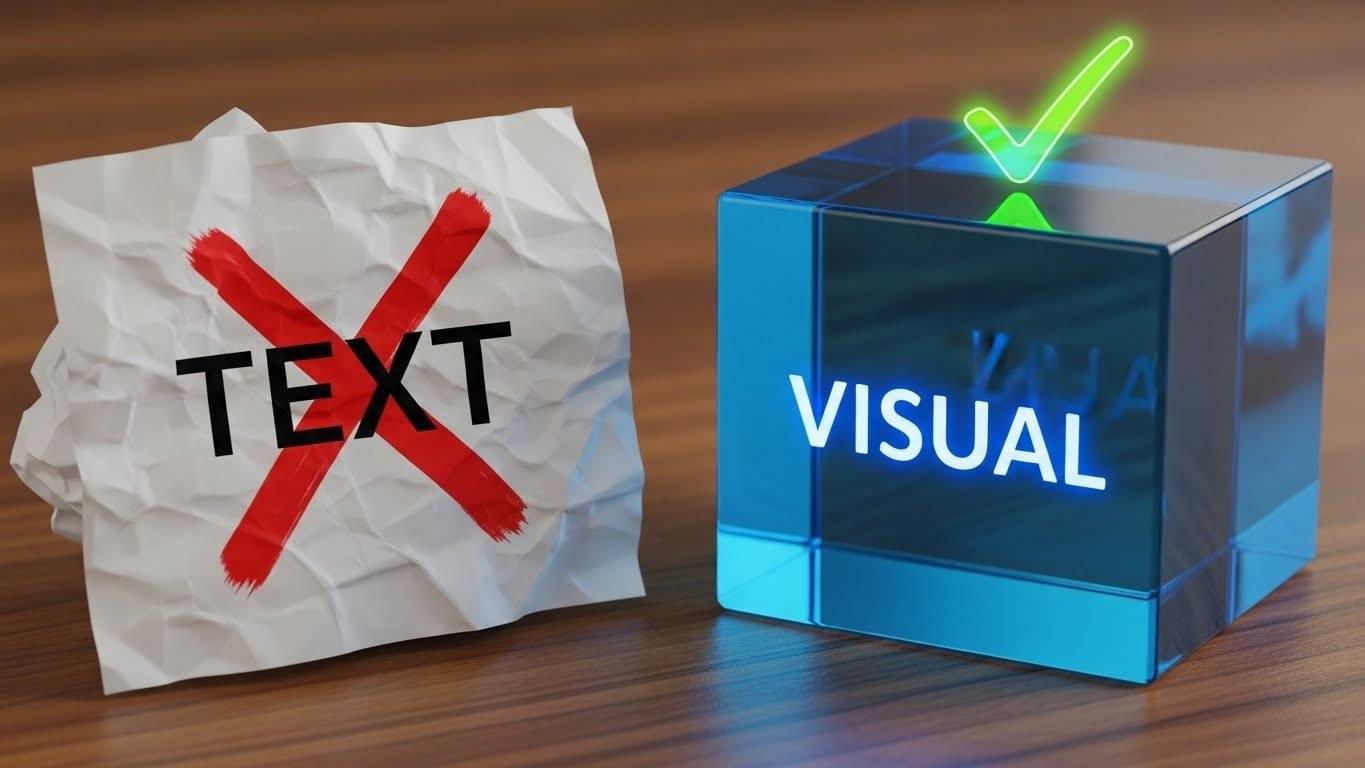
The Discovery: In my testing, visual data (charts/screenshots) has a higher "Trust Score" than written text.
The Strategy: The "Redundant Signal" Protocol. We must encode our keywords into the pixels themselves, not just the metadata.
Most SEOs think of images as "decoration." They think Google looks at the filename (keyword.jpg) and moves on.
They are operating on a 2015 mental model.
In the Gemini Era, images are not decoration. They are Heavy Tokens.
To understand Visual GEO, you need to understand Vector Space.
When Gemini scans your article, it doesn't just read the words. It converts your text into a long list of numbers (a Vector).
Then, it looks at your image. It runs a "Vision Encoder" (like CLIP or SigLIP) to convert the pixels into a list of numbers (another Vector).
If the Text Vector and the Image Vector point in the same direction mathematically, your "Relevance Score" doubles.
If they point in different directions, you are ignored.
I spent the last 48 hours in the Infomly Lab testing the limits of this "Multimodal" brain.
The "Contradiction" Experiment
I wanted to know: Who does Gemini trust more? Me (The Writer) or The Evidence (The Image)?
The Setup:
I wrote a paragraph saying: "The price of Replit Agent is $50/month." (This is a lie).
I uploaded a screenshot of the Replit pricing page clearly showing "$20/month." (The Truth).
I asked Gemini: "How much is Replit Agent?"
The Result:
Gemini answered: "Replit Agent costs $20/month, based on the pricing image provided."
The Implication:
The AI overrode my written text because it assigned a higher Truth Probability to the pixels (OCR Data).
In the hierarchy of GEO, Visual Proof > Written Claims.
This changes everything. It means your images are the primary source of truth for the algorithm.
The "Redundant Signal" Protocol
If visuals override text, we must ensure our visuals are engineered to carry the Primary Keyword Payload.
We do this through Signal Redundancy. We want the Text Vector and the Image Vector to scream the exact same data point.
How to execute this:
1. The "OCR" Injection
Optical Character Recognition (OCR) is how Gemini reads text inside images.
Weak Signal: A stock photo of a laptop. (Vector = "Computer, Work, Office").
Strong Signal: That same photo with a text overlay: "How to Rank in AI." (Vector = "Computer, Work, AI Ranking").
The Lab Rule: Never publish a header image without a Text Overlay. You are wasting "Visual Real Estate" if the image doesn't contain the H1 keyword in pixel form.
2. The "Vector Alignment" Chart
If you are writing a comparison post (e.g., "Gemini vs ChatGPT"), you typically write a conclusion.
That is not enough.
You must visualize that conclusion in a chart.
Why: Graphs create highly specific Vector Embeddings. A bar chart showing "Gemini" higher than "ChatGPT" creates a mathematical relationship that is harder for the AI to misunderstand than a nuanced paragraph.
Tactic: Use tools like Canva or Python to generate simple bar charts for every data point you make.
3. Semantic Density in Screenshots
When taking a screenshot (e.g., of a software tool), Context is King.
Bad: Cropped tightly on a button. (Low semantic density).
Good: Wide shot showing the URL bar, the sidebar, and the specific feature. (High semantic density).
The more "context clues" (UI elements, logos, URLs) you leave in the screenshot, the more "Anchor Points" the Vision Encoder has to map the image to the correct topic.
The Future: "Multimodal RAG"
We are entering the age of Multimodal RAG (Retrieval-Augmented Generation).
Search engines are no longer just retrieving text chunks; they are retrieving image chunks.
If a user asks: "Show me the traffic drop from the Google Leak," Gemini looks for an image that matches that vector first, then looks for the text to explain it.
If you have the text but not the graph, you lose the query.
Final Verdict
Stop treating images like "Art." Start treating them like Data Containers.
Every pixel on your site is an opportunity to confirm your authority.
If you claim it, graph it.
If you review it, screenshot it.
If you teach it, diagram it.
Give the "Vision Encoder" exactly what it wants: High-Contrast Truth.
Frequently Asked Questions (FAQ)
Does Google actually "read" charts?
Yes. In the Google API documentation (and recent Gemini demos), they explicitly show the model's ability to parse X/Y axes, read legends, and interpret trends in line graphs without any surrounding text.
What file format is best for Vector Search?
Technically, the format (WebP vs JPG) matters for speed, but the content matters for vectors. However, SVG (Scalable Vector Graphics) is the "Nuclear Option" because SVGs are code. LLMs can read the code and see the image. Use SVG for logos and simple icons whenever possible.
Can I use AI to generate these charts?
Yes, but be careful. Generative AI (like Midjourney) often misspells text. It is better to use a Data Visualization tool (like Flourish or Excel) to create the chart, then take a screenshot. Do not let AI hallucinate your data.