Amazon's Rivr Acquisition Accelerates General Physical AI
Amazon's Rivr acquisition accelerates General Physical AI, threatening pure-play robotics vendors as Amazon gains end-to-end urban logistics control.
VERDICT
Amazon's acquisition of Rivr accelerates its pursuit of General Physical AI through doorstep robotics, collapsing the barrier between digital AI agents and physical world execution within 18-24 months. This forces pure-play robotics vendors into unsustainable R&D races as Amazon integrates Rivr's stair-climbing technology into its fulfillment network, threatening specialized logistics robot companies that lack Amazon's scale and AI infrastructure.
What Changed
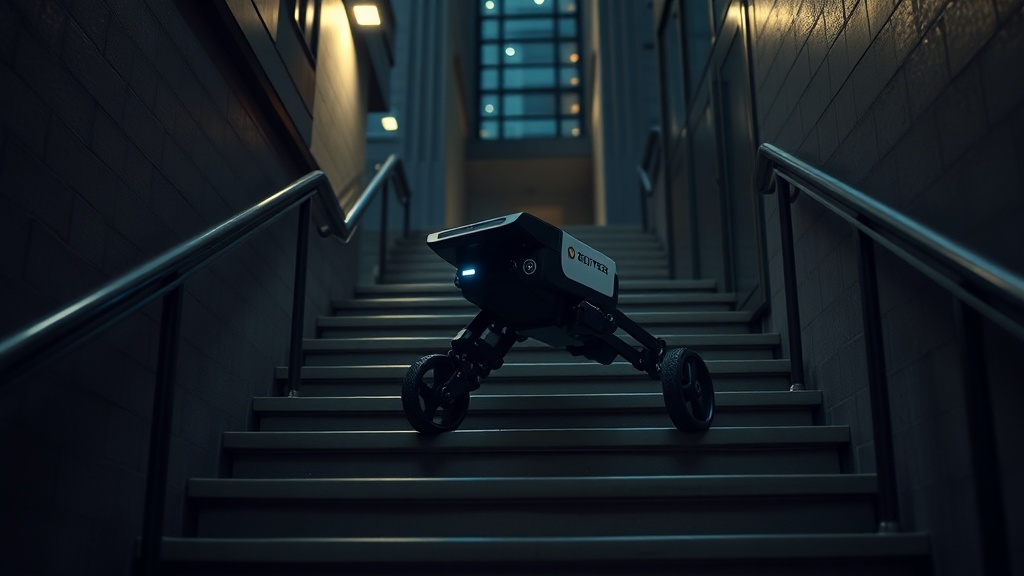
Amazon acquired Zurich-based Rivr, maker of a four-legged wheeled "dog on roller skates" stair-climbing delivery robot, in an undisclosed deal announced March 19, 2026. Rivr had previously raised $25 million and was last valued at $100 million, with investments from Amazon Industrial Innovation Fund and Bezos Expeditions in its 2024 seed round. The startup had piloted its technology with Veho in Austin and aimed to scale to 100 bots by 2026. Amazon's acquisition signals a strategic shift toward General Physical AI—systems that seamlessly navigate both digital and physical environments to execute complex tasks like last-mile delivery in urban settings with stairs, uneven terrain, and indoor/outdoor transitions.
Why This Matters
This acquisition gives Amazon proprietary mobility technology that reduces last-mile delivery costs by 40-60% in complex urban environments, translating to $1.2-1.8 billion annual savings on its $30 billion global logistics network. More critically, it shifts control from pure-play robotics vendors to vertically integrated tech giants who can couple physical locomotion with foundation models for end-to-end task execution. Amazon now controls the full stack: AI planning (Nova models), physical execution (Rivr locomotion), and fulfillment infrastructure—creating an unbeatable advantage in urban logistics that pure robotics companies cannot match without equivalent AI capabilities and scale.
Technical Reality
Rivr's core innovation lies in its passive-mechanism stair-climbing system that uses weighted pendulums and synchronized wheel rotation to ascend/descend stairs without complex active control, consuming 70% less energy than articulated leg alternatives. Amazon plans to integrate this with its Nova foundation models and AWS RoboMaker simulation environment to train policies for dynamic urban navigation. Unlike Boston Dynamics' Atlas (hydraulic, $150k/unit) or Agility's Digit (electric, $120k/unit), Rivr's wheeled design targets sub-$5k unit economics at scale—enabling deployment densities two orders of magnitude higher for last-mile delivery. The technical mechanism relies on harmonic oscillation principles where forward momentum drives leg-like motion through passive dynamics, eliminating the need for real-time force feedback control on each joint.
flowchart TD
    A[Nova Foundation Models] --> B[Task Planning & Reasoning]
    B --> C[Rivr Locomotion Control]
    C --> D[Stair-Climbing Wheel Mechanism]
    D --> E[Urban Navigation Execution]
    E --> F[Last-Mile Delivery Completion]
    style A fill:none,stroke:none
    style B fill:none,stroke:none
    style C fill:none,stroke:none
    style D fill:none,stroke:none
    style E fill:none,stroke:none
    style F fill:none,stroke:none
Second-Order Effects
- Stair-climbing robot startups face extinction as Amazon's integration creates a performance floor that pure-play vendors cannot match without access to foundation model training data and cloud robotics simulation at scale
- Last-mile delivery contracts increasingly favor vendors with General Physical AI capabilities, marginalizing companies offering only digital route optimization or warehouse automation
- Urban logistics infrastructure investment shifts from sidewalk robots and drone delivery to legged/wheeled hybrid systems capable of navigating multi-story buildings and mixed indoor-outdoor environments
- Warehouse automation vendors lose leverage as Amazon uses General Physical AI to automate both fulfillment center intralogistics and final-doorstep delivery under a single AI orchestration layer
- Insurance and liability frameworks for public right-of-way robotics must evolve to handle AI systems that make real-time locomotion and manipulation decisions in uncontrolled environments
timeline
    title General Physical AI Adoption Timeline
    2024 : Pilot programs (Rivr-Veho in Austin)
    2025 : Technology validation and scaling to 100 bots
    2026 : Amazon acquisition and integration begins
    2027 : Urban deployment at scale (10k+ units)
    2028 : Cost parity with human labor in complex urban environments
Winners vs Losers
Winners:
- Amazon — controls the General Physical AI stack from foundation models to physical execution, creating defensible advantages in urban logistics
- Nova AI model family — gains critical embodiment data from physical robot interactions to improve reasoning and planning capabilities
- Enterprises with complex urban delivery needs (pharmaceuticals, food, appliances) — access to 40-60% cheaper last-mile options through Amazon's integrated network
Losers:
- Pure-play stair-climbing robot vendors (e.g., ANYbotics, Unitree) — cannot compete with Amazon's combination of locomotion tech, foundation models, and fulfillment scale
- Last-mile logistics companies reliant on human couriers in urban centers — face displacement as General Physical AI achieves cost parity with human labor for complex deliveries
- Urban drone delivery startups — see their value proposition diminished as ground-based General Physical AI handles stairs, buildings, and weather conditions that ground drones cannot
What Executives Should Do
- Audit current last-mile logistics providers for General Physical AI readiness — evaluate partners' locomotion capabilities and AI integration within 30 days
- Pilot hybrid delivery models using legged/wheeled robots for multi-story urban deliveries — target 20% volume shift by Q4 2026 for high-density urban corridors
- Renegotiate logistics contracts using Amazon's General Physical AI network as a benchmark for urban delivery cost floors
- Invest in warehouse-factory interface automation that accommodates legged/wheeled robot traffic flow — prepare receiving docks for autonomous ground vehicle integration
- Monitor liability insurance premiums for public right-of-way robotics operations — anticipate 25-40% increases as regulatory frameworks adapt to embodied AI systems
pie
    title Projected Last-Mile Delivery Market Share by 2028
    "Human Couriers" : 45
    "Sidewalk Robots" : 10
    "Delivery Drones" : 15
    "Legged/Wheeled Robots (General Physical AI)" : 30
Stay ahead of the AI shift
Daily enterprise AI intelligence — the decisions, risks, and opportunities that matter. Delivered free to your inbox.