Jensen Huang's AGI claim accelerates Arm's disruptive CPU shift
Arm's in-house AGI CPU launch structurally undermines Nvidia's data center dominance by enabling partner-controlled inference at scale.
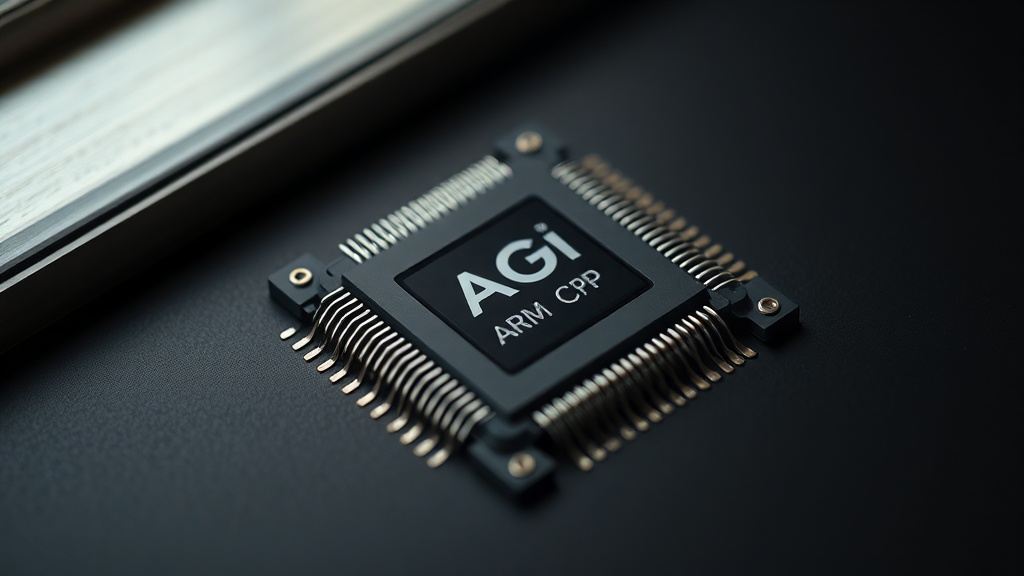
Jensen Huang's AGI claim accelerates Arm's disruptive CPU shift
Arm's first in-house CPU, designed specifically for agentic AI workloads, creates a parallel compute track that challenges Nvidia's data center dominance by enabling partners to bypass GPU royalties for inference tasks.
What Happened
At GTC 2026, Arm announced its Arm AGI CPU — its first in-house processor designed for data center agentic AI workloads. Jensen Huang stated that once existence/proof of a technology is seen, refinement takes less than five years. Arm projects its data center AGI chip will generate roughly $15 billion in annual revenue within five years, with Meta confirmed as lead partner and co-developer to deploy an efficient compute platform across its services. The Arm AGI CPU undercuts x86 CPUs in capacity per gigawatt and claims doubling of performance per rack compared to x86.
Why This Matters
Arm's shift from royalty-based licensing to direct AI data center silicon sales creates a structural threat to Nvidia's ~90% AI training market share by diverting inference spending to a partner-controlled CPU stack. For enterprises running continuous agent workloads, this translates to potential savings of $7–10B annually on a $20M inference budget as partners avoid GPU royalties while gaining performance efficiency. The control shift moves inference workloads from Nvidia's GPU monopoly to a consortium of Arm, Meta, Google, and Microsoft who now influence foundational AI chip design.
Under the Hood
The Arm AGI CPU is engineered specifically for agentic AI's continuous reasoning workloads, which require sustained data-crunching rather than the burst parallelism needed for LLM training. By targeting capacity per gigawatt and performance per rack, Arm delivers 2x the efficiency of equivalent x86 processors — a direct result of its RISC architecture optimized for predictable, scalar workloads. Partners like Meta co-developed the chip to handle agentic AI's data-processing needs at global scale, creating an alternative inference pipeline where workloads can run on CPU-only infrastructure without GPU involvement for tasks that don't require massive parallelism.
The Other Side
Nvidia maintains that its GPUs remain irreplaceable for large-scale AI model training due to superior parallelism and the CUDA ecosystem, and that agentic AI may still rely on GPU-intensive components for complex reasoning tasks. This suggests Arm's CPU displacement may be limited to simpler inference workloads, preserving Nvidia's high-margin training dominance. However, the structural threat lies in the inference layer — where agentic AI spends most of its operational time — and if even 30% of inference workloads shift to Arm's CPU economics, Nvidia faces material revenue pressure from its data center TAM.
What Breaks Next
Traditional GPU-dependent inference contracts become structurally unsafe at scale as partner-controlled CPU alternatives mature — enterprises locked into single-cloud inference agreements will overpay as Arm's AGI CPU gains traction in partner clouds for agentic AI pilot workloads within 0–6 months.
Winners and Losers
Arm — gains direct revenue from AI data center silicon (vs. royalty-only model) and shifts power balance with partners by offering competitive CPU alternative to Nvidia GPUs
Meta — secures influence over foundational AI chip design to optimize for its workloads and reduce dependence on Nvidia's supply chain
Enterprises with bursty agent workloads — realize 2x performance per rack vs. x86, cutting inference costs for continuous reasoning tasks
At risk:
Nvidia — faces erosion of its data center TAM if agentic inference workloads migrate to Arm's CPU stack, threatening its high-margin GPU dominance in AI infrastructure
Intel/AMD — lose potential licensing revenue as Arm bypasses traditional CPU merchant model for partner-developed AI chips
Cloud vendors locked into GPU-centric inference contracts — face margin compression as enterprises migrate workloads to avoid GPU royalties
What Nobody's Talking About
The Arm AGI CPU's success assumes agentic AI workloads are sufficiently deterministic and parallelizable to run efficiently on CPUs — if they require GPU-like parallelism for complex reasoning, the performance advantage may not materialize. More critically, partners may adopt Arm's AGI CPU not for performance but to break Nvidia's supply chain dependence, making adoption a strategic move rather than pure economic decision.
Where This Goes
Now (0–6 months): Arm's AGI CPU gains traction in partner clouds for agentic AI pilot workloads, forcing Nvidia to justify GPU pricing for inference tasks where power efficiency matters
Next (6–24 months): Agentic AI workloads increasingly favor Arm's CPU economics for continuous reasoning, creating a dual-track AI infrastructure where Nvidia dominates training but loses inference share to partner-controlled CPU alternatives
Executive Playbook
- Audit current AI inference workloads for suitability to CPU-based architectures — complete within 30 days
- Pilot Arm AGI CPU instances for continuous agent workflows — measure performance per watt against GPU baselines within 60 days
- Renegotiate cloud inference contracts using Arm-based alternatives as leverage to escape GPU royalty structures
Stay ahead of the AI shift
Daily enterprise AI intelligence — the decisions, risks, and opportunities that matter. Delivered free to your inbox.